
Failure is a Gift
Failure is one of the few words that can stop a student (or a parent) in their tracks. It carries shame. Fear. A sense that something important has been lost. And yet, I’ve come to believe this: failure may be one of the greatest gifts education has to offer, if we let it be.
As a student who generally got good grades, and a parent of two teenage children cut from a similar cloth, I strongly appreciate the sentiment that, as a student, you strongly prefer not to experience failure, nor anything close to it, if at all possible. And yet, failure-avoidance is one of the core problems with our schooling system. The focus on performance success has been externalized and systematized to fit a scoring system of just 5 letter grades. Driven by universities’ needs to sort and rank potential candidates for admission, the race is on from 9th grade to build the highest possible GPA. Anything less, and you’re slipping toward ‘failure’.
Speaking with an independent high school leader last week, I asked what one thing they would change to help improve our educational system if they had a magic wand. The answer? Stop giving grades. Students focus on the grade, and not on the learning. They get very good at “doing school”, but miss out on the deeper learning potential, not to mention the ‘why’ of it all. Plus, they confided, if a high school stops providing grades, the universities will disadvantage their students at admissions.
Fear of Failure is Self-Fulfilling
With the decreasing relevance of higher ed being the canary in our collective educational coal mine, it’s worth revisiting the marshmallow tower challenge recently referenced so thoughtfully by @Patrick Dempsey. Kindergarteners are shown to be more mentally nimble and collaboratively iterative in their approach to constructing a tower of marshmallows and spaghetti than are teams of MBA graduates. Is our education system failing students the longer that they stay in it? Kids, given a Design Thinking challenge, waste little time trying out novel solutions, sharing best practices with peers, and quickly navigating the small ‘failures’ along the way, iterating repeatedly. Adult students, on the other hand, spend more time talking, pontificating, sharing any book smarts that might benefit, and winning over peers for the eventual solution employed.
Together, these behaviors reveal one clear trend:
The longer students stay in school, the more they learn to avoid risk rather than explore possibility.
Failure = Misapplied Success
We need to reframe failure. Failure is not an end point, nor the forever denial of success, but rather it is a lesson or set of lessons that, if taken on board, can lead to far greater success (and resilience) than a simple, early success might provide.
Consider the famous story of ‘Post-Its’, created by 3M. Originally, one of their adhesive research scientists was trying to create a super-strong glue, but instead landed on a really weak one, that could be re-stuck over and over without losing all of its stickiness. The company set this ‘failed’ formula aside, until several years later, when another of its scientists thought this weak glue could function to keep bookmarks from falling out of books. The sticky bookmark product was a quick flop – rejected by consumers as unnecessary. However, when 3M followed the design cycle through a few more loops, they got to Post-It™ Notes, which have since been the category leader for decades.
Hair growth was a side effect of the approved heart medication Minoxidil, and eventually became the primary use of this drug. Viagra, in fact, was initially a failed heart medication – now look how successful it’s become! Many more such discoveries happened in similar fashion.
Again and again, what we label as failure turns out to be nothing more than misapplied success, waiting for a better question.
Failure = Fuel
We all probably know of at least one amazing sports icon who was initially overlooked as well. Famously, Michael Jordan was cut from his high school varsity team as a Sophomore. Failure was a gift to him. From there, he went on to become NCAA Champion, 6x NBA Champion, 5x MVP, 10x Scoring Leader, and on and on and on.
What we might be inclined to label as failure here is in fact the feedback that activated and motivated these underlying talents to their world-record achievements.
Let’s be clear – this is not an article about people at the very top of their game, rather, this is about students, at ALL levels, still developing their game. And what happens when those students experience failure.
From Grade-ification to Gratification
I went to college convinced that I was going to study aeronautical engineering. In my sophomore year, I had the fortune of studying under a Nobel laureate in Physics. Unfortunately, I discovered that having world-class research instincts does not make one a great teacher. In fact, this was the most boring and painful class to which I’ve ever been subjected. After half a semester, carrying an A- into and following the midterm, a close friend and I determined that, going forward, we would review lecture notes for the remainder of the course while skipping the actual lectures. We attended all labs and kept up with homework. However, when the review section for the final exam came around, I realized how disconnected from the course material I had become. With 50% of my grade riding on the final, I pulled an all nighter to review and prepare for this all-important mark, which could spell my success at going for an engineering degree. I failed the final and netted a C in that Physics course.
At the time, I was bereft and ashamed. I couldn’t believe how I had let myself down and undermined my future plans. In retrospect, I recognize that as one of the most pivotal moments, determining the direction of my life. I had to choose whether to retake the course for a higher mark in order to continue pursuing engineering, or to take a different path.
As hard as it was at first to get over my ego and to consider changing directions, once I had allowed myself that consideration, the world opened up for me. I’ll never forget the curiosity and empowerment involved in wandering through the entire course catalog as if it were a tasty restaurant menu. Mmm – a little of this sounds good. Oooh – I wonder what that’s like! Yeah, I’ll pass on that one. The freedom to chart my course was liberating. I circled classes that most appealed, dog-eared pages, flipped back and forth looking for thematic alignments, weighing options. Psychology, neuroscience, mass communications, business, political science, cultural anthropology, sociology, economics – it all seemed so interesting and, when it dawned on me that I still had time to right my academic ship, I wove together a semi-independent major in the Social Sciences that intertwined them all. From that moment forward, school felt invigorating, purposeful, a series of discoveries and adventures into what fascinated me most.
My failure to get my desired grade in Physics forced me to think harder about the path I was on, to verify that I really meant what I had set out to conquer. Changing directions was not a sign of failure, but one of realization, then choice, then embracing discovery.
I moved from performance to purpose.
After many years’ focused on grades and expectations, I returned to a love of learning that I had not felt since elementary school, and to a strong intrinsic motivation around discovery and service.
As well, I realized that in my studies till that point, I had been frustrated, bored, arrogant and even self-righteous, and it had led me to one of the most confronting lessons of my schooling. I never again took my place in any course for granted until I had done all that I possibly could to learn and to deliver my best. My failure led to many future and sustained successes.
Fail Fast
In entrepreneurial start-up culture, a commonly heard mantra is, “Fail fast.” That is, when you’re pre-revenue, trying to show product-market fit, aka consumer “traction”, you cannot afford to spend all your time and investment money to get everything right on the first try. If you don’t have funds and financial runway remaining, and you’ve made the wrong bet as to what consumers would most want in your product, you’re done. It’s over. If, on the other hand, you stand up your product as quickly and as inexpensively as possible, even if your consumers do not warm to your initial offering, you still have the ability to iterate, perhaps even to pivot entirely (change direction and rebuild with a new vision). Failing fast means you give yourself the opportunity to learn from mistakes, missteps, or misjudgments, and then to apply those lessons to forward-looking successes yet to come.
Elon Musk’s SpaceX has experienced 5 out of 11 of its super-jumbo Starship rockets exploding in unmanned flight tests (*as of the date of this release), not to mention numerous additional pre-flight explosions in early development, so that they can perfect the technology to support transport of human and other biological cargo toward the Moon, Mars, and perhaps beyond.
That’s just a 45% success rate! Most teachers would fail those students.
But because every test provides new, and sometimes unexpected data, the team understands better the forces at hand, the stress points, the systems which need to be hardened, and which elements should be completely re-engineered. It also identifies further tests that the team must consider to bolster future success. With each failure, the team gets smarter and the successive build gets better.
This IS the marshmallow experiment. Really. Just with a much taller “tower”, and a heap more dollars than a pack of marshmallows. Fail fast!
Failure = Feedback
Failure isn’t judgment. Failure is feedback.
For those who may be unfamiliar, the Design Cycle is a powerful tool used successfully for a number of years now in education, and for many decades previously in product design, marketing and innovation.
The Design Cycle applies to anything – product, service, event, etc. – that touches humans. It starts with empathy. You Empathize with those you serve. Human-centric.
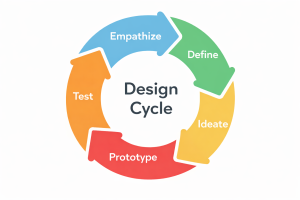 The loop proceeds in step to Define the problem(s) and the population(s) to be addressed, and then to Ideate possible solutions. To ensure solutions are appropriate, designers share observations, reflections, and eventually ideas with the people to be served, to ensure that any product eventually offered is designed best for them. Once designers have created a Prototype of their product, service or event, they Test it with actual constituents to verify whether what they think is so fantastic actually is. The loop then circles back on itself – they reflect on what worked, what didn’t, and how they might do things differently, then they iterate.
In business, the term Continual Process Improvement describes a similar approach. The Japanese call the process of making small incremental improvements in iterative fashion like this Kaizen. And if you get the flywheel of the Design Cycle going fast enough, and you listen to feedback without judgement and take it onboard, you’re going to learn a whole lot, quickly.
While educators have taken to employing Design Thinking in K-12, letter grades still drive the ‘why’ of education more than do consumer outcomes or living constituent benefits. As such, students may often miss the point of the Design Cycle, and the point of education altogether – that you don’t ever stop learning and iterating. You don’t finish a project and simply move on to the next when people are counting on your efforts at continuous improvement around a product that serves their real life needs. You don’t give up on searching for cures to cancer as a researcher when lives are at stake; even when one avenue leads to a cul de sac, you just re-widen your perspectives and chart your next exploratory path forward. When the online service you’re offering players doesn’t appeal as intended – as a game – but part of its feature set is welcomed for its unique benefit – as a communications tool – it becomes Slack.
Welcoming the Gift
Grades will not disappear overnight. And even when they do, humans will still perceive varying levels of success, the lowest of which will resemble and still be commonly referred to as ‘failure’. The key to unlocking eventual success will remain the same – let go of any stigma and ego-bruising around the word failure. Listen carefully to feedback not as judgment but as insight, and more nuanced direction. Then, dust yourself off, and get on with applying the lessons learned.
As the year draws to a close, many of us naturally take stock – of what went well, and what didn’t. Of goals met, and expectations missed.
What if we softened the language we use with ourselves, and with our students?
What if failure was seen as a natural part of learning, and not the opposite of success?
Lessons don’t diminish us. They refine us. They point us toward better questions, deeper understanding, and more meaningful growth.
Failure, when met with curiosity rather than shame, becomes a gift – one that keeps giving long after the moment has passed.