
AI Is Already in the Classroom - Just Not Equally
When new technologies enter education, they rarely arrive all at once or in the same way everywhere. They arrive unevenly, shaped by access, training, leadership, and teacher confidence. Artificial intelligence is no exception. What is different is the speed, opacity, and stakes of its adoption.
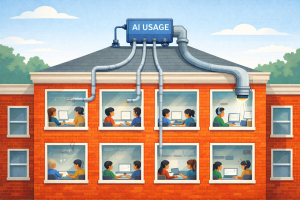
Data from a 2025 Gallup survey suggests roughly 60% of K-12 teachers in the U.S. already use AI in some aspect of their practice – lesson preparation, assessment, or instruction – yet most are doing so often quietly, informally, and without guidance. At the same time, nearly 30% of teachers oppose AI use altogether, whether by policy, uncertainty, or fear. The result is not a simple divide between “innovators” and “laggards,” but a highly fragmented instructional landscape where students’ experiences with AI depend heavily on which classroom they happen to be in.
These differences translate into inconsistent expectations for acceptable use-cases and policy enforcement for students, with the greatest disparities appearing between well-resourced and under-resourced schools.
This pattern is not new. We have seen it before, repeatedly.
What Past Technologies Can Teach Us
Consider several major instructional technologies from the last few decades:
Computers in Classrooms
Personal computers began appearing in schools in the 1980s, but it took nearly 25 years for access to become widespread and instructional use to normalize. Early adoption was concentrated in affluent districts, while others relied on shared labs or had no access at all. For years, computers were often used for isolated skills practice rather than integrated learning, largely because teachers were not trained to redesign instruction around them.
The Internet
Although the internet became publicly available in the mid-1990s, it wasn’t until the late 2000s that high-speed access reached most classrooms. Even then, instructional use lagged behind availability. Students in some schools learned to research, collaborate, and publish digitally; others used the internet sparingly or not at all. The gap wasn’t just about infrastructure; it was about teacher preparedness and confidence.
Interactive Whiteboards
Marketed as transformational tools in the early 2000s, interactive whiteboards reached many schools within a decade. Yet studies and classroom observations repeatedly showed that they were often used as expensive projection screens, not interactive learning tools. Adoption was fast; meaningful instructional change was not. Without sustained professional learning, the technology simply reinforced existing teaching practices rather than improving them.
1:1 Devices
Laptops and tablets scaled more quickly – many districts reached high levels of access within 8-10 years. But even here, implementation quality varied widely. In some classrooms, devices supported creation, feedback, and differentiation. In others, they became tools for digital worksheets or test prep. Again, the determining factor wasn’t the device; it was how prepared teachers were to use it well.
Across all of these examples, one pattern holds: it typically takes a decade or more for technologies to reach 80%+ adoption, and even longer for effective instructional use to become consistent. AI, so far, is proving to be no exception.
Why AI Is Following the Same Pattern – Faster
AI is entering schools through a different door.
Unlike previous technologies, AI:
- Requires no hardware rollout
- Is already embedded in tools teachers and students use
- Is accessible outside school regardless of policy
- Produces outputs that appear authoritative
As a result, AI adoption is happening before systems have had time to respond.
Some teachers are experimenting independently – using AI to plan lessons, generate feedback, or support differentiation. Others are unsure where the boundaries are and choose avoidance. Still others, despite best intentions, may use AI in ways that are inefficient, inappropriate, or misaligned with learning goals – not out of negligence, but for lack of training.
These behaviors create several real risks for students, and for teachers themselves.
The Risks of Uneven AI Adoption
Inconsistent Learning Experiences
Students are encountering fundamentally different expectations depending on their teacher’s comfort with AI. In one classroom, AImight be used to deepen thinking and support revision. In another, it may be banned outright. In a third, it may be used uncritically. This inconsistency undermines coherence across courses and grade levels. The lack of a clear, widely accepted approach to AI can lead students to question whether their teachers know what they’re doing.
Widening Equity Gaps
Historically, under-resourced schools are slower to receive training and support, even when tools are technically available. When AI literacy develops informally rather than intentionally, students with fewer outside resources are the least likely to benefit and the most likely to be penalized for misuse.
Erosion of Instructional Judgment
Without guidance, teachers may rely too heavily on AI outputs – or avoid them altogether – rather than learning how to evaluate, adapt, and integrate them thoughtfully. The result is not better teaching, but diminished professional agency.
Policy–Practice Mismatch
More than three years since the release of ChatGPT, many schools still do not have an official AI policy, which speaks to their uncertainty and caution about the technology. That said, top-down rules cannot keep pace with how quickly AI tools evolve. When policies are unclear or overly restrictive, teachers are left to navigate gray areas alone, increasing stress and inconsistency.
Why This Must Be Addressed Now
If history is any guide, waiting for AI adoption to “settle” on its own will take years, and the instructional consequences will accumulate in the meantime.
The lesson from past technologies is clear: access does not equal impact. Adoption does not equal improvement.
What makes the difference is whether teachers are:
- Included in conversations about how technology affects their practice
- Given time and space to build understanding
- Supported in developing professional judgment, not just technical skill
AI will not succeed or fail in schools because of its capabilities. It will succeed or fail based on whether educators are prepared to use it intentionally, ethically, and in service of learning.
The uneven classroom landscape we are seeing now is not a temporary inconvenience; it is a call for immediate, intentional action. It is an early warning sign, and an opportunity to respond differently than we have in the past.