
Deeper Learning Requires a Leap of Faith
What does it take for a student to risk being wrong or looking stupid in front of their peers?
To raise a hand when they’re unsure… to share a half-formed idea… to admit they need help… to try something they’ve never done before?
Most of the time, we say this is a matter of confidence or motivation. But what if the real story is about trust: in us, in peers, and in the environment we create?
I learned this lesson years ago as an Outward Bound (OB) counselor, leading groups of students and educators to climb ropes, solve problems, and stretch themselves. Amid all the team challenges and cooperative puzzles, one experience stands apart in my memory, for both its intensity and its lessons:
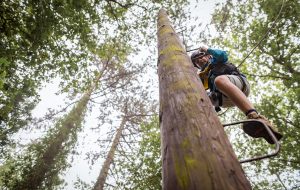 THE PAMPER POLE
Standing Atop a 26-Foot Question Mark
Imagine this:
You’re safely harnessed in.
You trust your belay partner (the person on the ground holding your rope securely.)
You’ve spent a long day solving physical and strategic challenges with your group.
But this time, you must climb alone – straight up an 8-meter telephone pole whose cold metal rungs are widely spaced apart. Encouraging voices below fade with each step up, replaced by voices in your own head.
At the top, there is no handle. No rail. No bars to lean on.
Just a plate-sized wooden circle. And your heartbeat.
Standing still on flat ground is simple. Standing still on a pole 26 feet in the air is anything but.
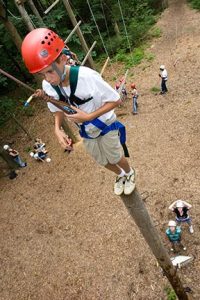 And then comes the part that steals your breath:
You are meant to jump – to hurl yourself off the top of the pole in order to tap a buoy suspended out of your reach, trusting that the rope and your belay partner will catch you.
Statistics and safety protocols don’t matter up there.
Logic gets quiet; fear gets loud.
And yet, this is where learning happens.
Why the Pamper Pole Works (and Why It Matters for Classrooms)
Outward Bound isn’t just about pushing bodies; it’s about surfacing the internal stories that shape what we dare to do, and how we navigate our learning within a social space. The Pamper Pole, though seemingly an individual task, reveals something profound about collective learning:
- Some climb halfway and turn back.
- Some won’t even consider approaching the pole.
- Some touch the first rung and freeze.
- Some reach the top but do not stand up.
- Some make the leap.
The value isn’t in how “far” each person gets.
The value is in what gets revealed in the collective debrief afterwards:
- What held you back?
- What moved you forward?
- Where does this show up in your life?
The debrief following each OB exercise is critical – allowing participants to reflect, gain insight, and get honest with one another. Often, students discover something about trust: trust in peers, trust in facilitators, trust in themselves. Sometimes the block is fear. Sometimes perfectionism. Sometimes a hidden emotional history. The social and emotional progress I witnessed at times in OB circles was profoundly inspiring, especially when students uncovered and released self-imposed limitations that had previously gone unrecognized, or when they realized one of their perceived fears had no basis in reality.
But here’s the insight that always lands with educators:
Students take risks when they feel they’ll be supported, not judged, even if they make mistakes.
The space needs to feel safe enough to fail.
That’s the real Pamper Pole in every classroom.
Translating the Lesson: What Helps Students Climb?
Every classroom has its own version of the pole:
- volunteering an idea
- leading a discussion
- admitting confusion
- giving peer feedback
- explaining solutions publicly
- trying a new method
Students step forward, or don’t, based on the trust we build.
Here are three mindset cues that can help you and them both move upward, rung by rung:
Stay Curious
Shift the narrative from “I have to do it all” to
“How far can I go today?”
Every step outside your comfort zone is progress. Curiosity dissipates pressure.
Stay Brave
Replace “I can’t do this” with
“I can try.”
Self-efficacy grows not just from success, but from evidence that effort is met with support.
Stay Alert
Courage isn’t recklessness.
Students must know that we honor both their “yes” and their honest “no”.
Internal cues – anxiety, past experiences, emotional overwhelm – are real data. Recognizing limits is also important learning, and an act of self-awareness we should honor.
Stay Connected
The Pamper Pole is a solitary act surrounded by a circle of cheering peers.
Classroom risk-taking is very much the same.
Community will amplify courage.
The Big Reveal: This Is Equity Work
When students feel psychologically safe:
- They participate more.
- They stretch further.
- They recover faster from mistakes.
- They perform closer to their potential.
And when they don’t feel safe?
They hide.
They shrink.
They disengage.
Sometimes the biggest barrier to a new pedagogical strategy, technology, or instructional routine is the same barrier at the Pamper Pole: It looks too daunting.
Students feel it. Teachers feel it. Administrators feel it.
But the principle holds:
Small steps matter. Big leaps come later.
So… What Do the Rungs Look Like in Your Classroom?
- How do you help students take their first small risk?
- How do you connect your students early so trust grows intentionally?
- How do you help students reflect on what helps them—and what holds them back?
- How do you make failure feel not just safe, but useful? (More on this in upcoming posts!)
Light, Low-Prep Resources You Can Facilitate Anywhere
You can find more detailed information about these and other activities to help build trust and understanding among your students:
- “What’s On Your Radar?” – a 5-minute warm-up to surface concerns and build mutual empathy
- Human ‘Gordian’ Knot – simple physical challenge that reveals communication patterns
- Trust Falls or Blind Trust Walks – more emotionally challenging exercises to develop confidence among classmates
- Rose – Thorn – Bud Reflections – a gentle routine for identifying risks, obstacles, and opportunities
None of these require any specialized equipment – only intention and follow-through.
If we want deeper learning, we have to build deeper safety.