
How to be happy...
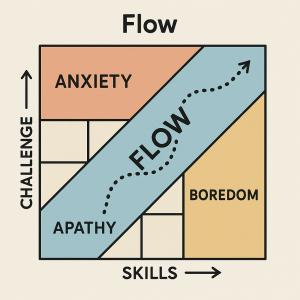 We’ve all had moments when we’re so absorbed in what we’re doing that hours slip by unnoticed. Maybe it’s reading a novel late into the night, sketching until the pencil dulls, or coding until dawn. Psychologists call this state flow—a period of deep concentration where challenge and skill balance so perfectly that time itself seems to disappear.
The term comes from Hungarian-American psychologist Mihaly Csikszentmihalyi, who in his 1975 book Beyond Boredom and Anxiety described flow as the “optimal experience.” It’s a state of high productivity and engagement, where a person is stretched just enough to match their level of mastery. In everyday language, we might call this being “locked in.”
Interestingly, Csikszentmihalyi didn’t start out searching for flow. His question was simpler: What makes people happy? Through studies of elite athletes, dancers, musicians, and later everyday professionals, he discovered that those who regularly accessed flow reported higher levels of life satisfaction. The state wasn’t confined to competition or artistry—gamers describe it when they execute a blur of rapid button combinations with uncanny precision, surgeons when they’re operating, writers when the words seem to pour effortlessly onto the page. The activity varies, but the feeling is strikingly universal.
In fact, Csikszentmihalyi and his colleague Judith LeFevre found that people were three times more likely to experience flow while working than during leisure or recreation. The implication here is important: when tasks are purposeful, structured, and challenging in the right way, they are more likely to induce flow than casual downtime. Schoolwork, then, has the potential to be not just obligatory but deeply engaging – if designed with this principle in mind.
So, if flow is such a powerful driver of joy and productivity, surely students are experiencing it in classrooms all the time, right? Ha!
The reality is sobering. In The Disengaged Teen, Rebecca Winthrop and Jenny Anderson describe the conditions under which young people enter “Explorer mode” – a state where curiosity, autonomy, and challenge combine to make learning meaningful. According to their research, only 4% of middle and high schoolers report being consistently in this mode. If that’s the foundation for flow, then the number of students regularly experiencing it during the school day is even smaller still.
But here’s the point: it doesn’t have to be this way. It shouldn’t be unthinkable to design classrooms with flow in mind. In fact, it may be a disservice to young people that the concept of flow is almost absent from educational design.
So what would flow in school actually look like?
- Purposeful work: Tasks feel meaningful, connected either to the real world or to the student’s own sense of purpose.
- Clear goals: Students know what they’re aiming for—or better yet, help define those goals themselves.
- Time and space: They’re given the chance to dive deep, without being constantly interrupted by bells, tests, or busywork.
- Aligned challenge: The level of difficulty matches their skill, pushing them to stretch but not to snap.
- Confidence and clarity: They believe they can succeed, and they know what steps to take next.
Anyone who has spent time in schools knows how rarely those conditions align. And yet, we also know what it looks like when they do: a student working intently on a science project long after the bell has rung, or a group of peers losing themselves in building a performance, design, or debate. These aren’t accidents. They’re glimpses of what education could be if flow were taken seriously as a design principle.
I won’t belabor the obvious mismatch between this vision and most classroom realities. If you follow my work, you’ll know I consistently emphasize the value of helping young people find purpose, engage with authentic, real-world challenges, see the interconnectedness of subjects, and receive the tailored support they need. Flow theory won’t singlehandedly fix what’s broken in our schools. But as we continue to reimagine education, it offers a crucial reminder: students aren’t just test-takers or grade-earners. They are learners, creators, and human beings.
And if we know what makes people happiest, most productive, and most alive – why would we design learning environments that ignore it?